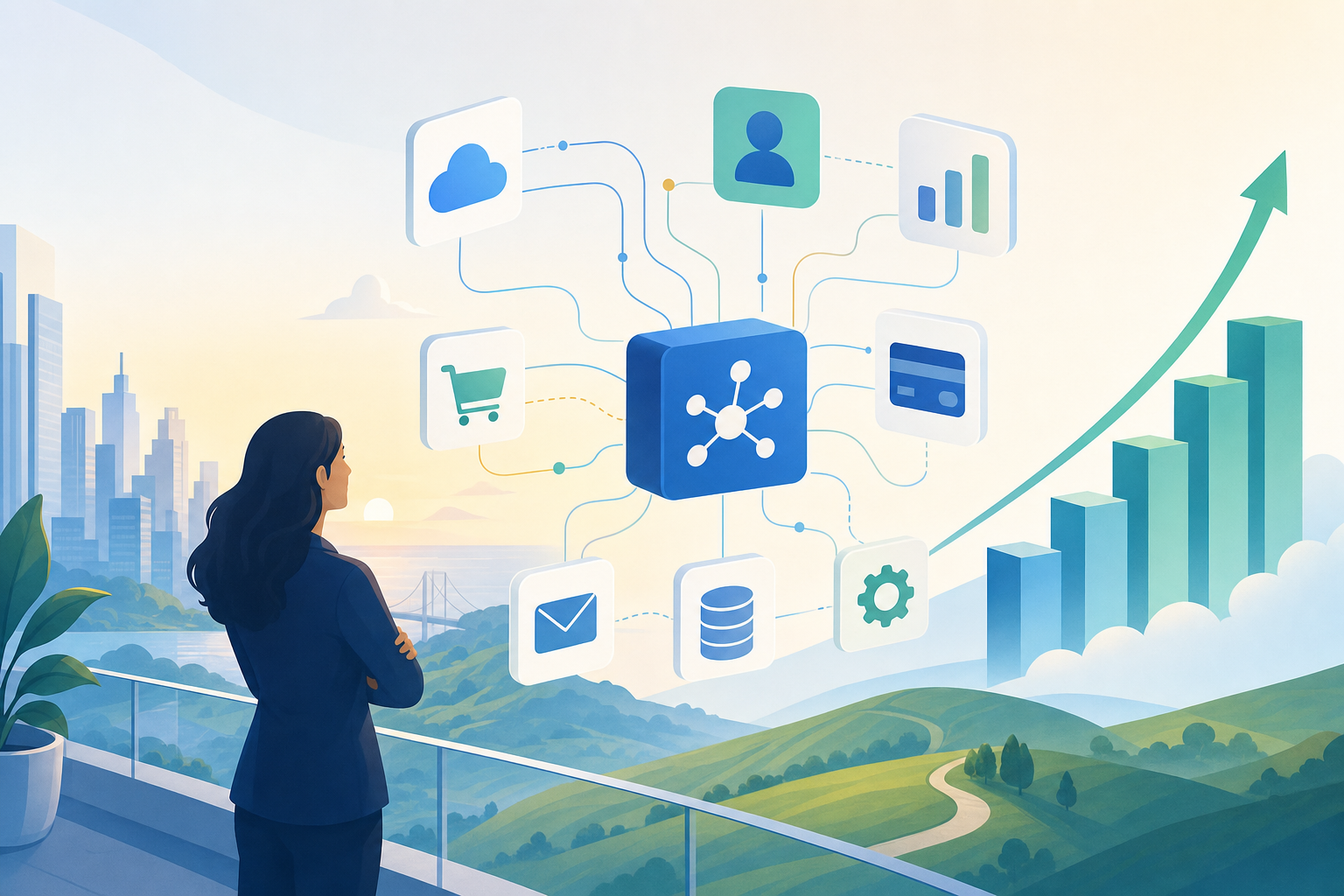
APIs Explained: What Every Non-Technical Founder Needs to Know
An API (Application Programming Interface) is a set of rules that allows different software applications to communicate with each other. Think of it as a waiter in a restaurant: you (the customer) tell the waiter what you want from the menu, the waiter takes your order to the kitchen, and the kitchen sends back your meal through the waiter. You never need to enter the kitchen or know how the food is prepared - the waiter (API) handles the communication between you and the kitchen (another software system).
Definition: An API is a standardized interface that allows one software application to request data or actions from another software application, without needing to understand the internal workings of that system.
Why APIs Matter for Your Business
Even if you never write a line of code, APIs directly affect your business in three critical ways:
1. Integrations
APIs are what allow your tools to work together. When your e-commerce platform automatically sends order data to your shipping provider, that happens through an API. When a new form submission on your website creates a contact in your CRM, that is an API connection. Without APIs, every tool in your business would be an isolated island, and you would spend hours manually transferring data between them.
2. Automation
APIs power the automations that save startups hundreds of hours. Tools like Zapier and Make work by connecting to different software APIs and passing data between them. When you set up an automation like "When a Stripe payment succeeds, add the customer to my Mailchimp list and create a record in Airtable," each of those connections is an API call happening behind the scenes.
3. Platform Ecosystems
The most powerful businesses - Shopify, Salesforce, Slack - became platforms by opening APIs that let other developers build on top of them. Shopify''s API allows thousands of third-party apps to extend its functionality. This creates a competitive moat: the more apps built on a platform, the more valuable the platform becomes to users, and the harder it is for competitors to replicate.
REST vs GraphQL: A Simple Explanation
The two most common types of APIs you will encounter are REST and GraphQL. You do not need to understand the technical details, but knowing the difference helps you make informed decisions:
| Feature | REST API | GraphQL API |
|---|
| How it works | Fixed endpoints that return predetermined data | Single endpoint where you specify exactly what data you want |
| Analogy | A set menu at a restaurant - you pick from predefined options | A build-your-own meal - you choose exactly which ingredients |
| Data flexibility | Returns all fields, even ones you don''t need | Returns only the fields you request |
| Adoption | Most widely used, industry standard | Growing, especially for complex apps |
| Ease of use | Simpler to understand and get started | Steeper learning curve but more powerful |
For most startups and no-code builders, REST APIs are what you will work with. They are straightforward: you send a request to a specific URL (called an endpoint), and you get data back in a structured format called JSON.
APIs That Every Founder Should Know About
You do not need to be a developer to benefit from understanding which APIs are available. Here are the most commonly used APIs in the startup world:
Payments: Stripe
Stripe''s API handles payment processing, subscriptions, invoicing, and financial reporting. It is the payment backbone of millions of businesses and is known for exceptional developer documentation. If you are building a SaaS product, Stripe will likely be your payment provider.
Communications: Twilio
Twilio provides APIs for sending SMS messages, making phone calls, and building video chat. If your product needs to send text message notifications or enable voice calls, Twilio''s API makes it possible without building telecom infrastructure.
Email: SendGrid / Postmark / Resend
Transactional email APIs handle order confirmations, password resets, and notification emails at scale. Marketing email APIs power newsletters and campaigns. These are different from using Gmail - email APIs can send thousands of messages per minute with delivery tracking and analytics.
AI: OpenAI
OpenAI''s API gives your application access to language models like GPT for text generation, analysis, and conversation. Understanding how AI agents work helps you evaluate where AI can add value to your product.
Maps: Google Maps / Mapbox
Location-based APIs provide mapping, geocoding (converting addresses to coordinates), routing, and place search. Essential for any product involving physical locations, deliveries, or local services.
API-First Businesses
Some of the most valuable companies in technology are fundamentally API businesses. Stripe sells an API for payments. Twilio sells an API for communications. Plaid sells an API for bank account connections. These companies recognized that packaging complex infrastructure behind a simple API creates enormous value - other businesses can add sophisticated capabilities to their products by making a few API calls instead of building from scratch.
If you are evaluating a startup idea, consider whether an API-first approach could work. The advantage is clear: developers (your customers) integrate your product into their code, creating deep switching costs and recurring revenue.
How to Evaluate API Providers
When choosing an API provider for your business, evaluate these factors:
- Documentation quality - Good documentation means your developer (or no-code tool) can integrate faster with fewer errors
- Reliability and uptime - Check their status page history. If their API goes down, your feature goes down
- Pricing transparency - Understand the pricing model (per API call, per user, tiered) and project your costs at scale
- Rate limits - How many requests can you make per second or per month? Will this limit your growth?
- Support and community - Active developer communities and responsive support reduce integration friction
- Data privacy and compliance - Especially important for health, financial, or European (GDPR) data
Key Takeaways
- APIs allow different software systems to communicate - they are the connective tissue of modern business tools
- You benefit from APIs every time your tools sync data, automate workflows, or connect to third-party services
- REST APIs are the most common and use simple request/response patterns; GraphQL offers more flexibility for complex needs
- API-first businesses (Stripe, Twilio, Plaid) create deep competitive moats through developer integration
- When evaluating API providers, prioritize documentation quality, reliability, and transparent pricing
Frequently Asked Questions
Do I need to know how to code to use APIs?
Not necessarily. No-code tools like Zapier, Make, and Bubble have built-in API connectors that let you integrate with APIs through visual interfaces. However, understanding what an API does and how data flows between systems helps you design better integrations even without coding.
Are APIs free to use?
It varies. Many APIs offer free tiers with usage limits (Stripe charges per transaction, not for API access; Google Maps offers a monthly free credit). Some APIs charge per request, per active user, or by data volume. Always model your API costs at your projected scale to avoid surprises.
What is an API key?
An API key is a unique identifier - like a password - that authenticates your application when making API calls. It tells the API provider who is making the request. Keep your API keys secure and never expose them in client-side code or public repositories. Leaked API keys can result in unauthorized usage and unexpected charges.
What happens if an API I depend on shuts down?
This is a real risk. When Google shut down several APIs or when Twitter drastically changed its API pricing, businesses that depended on them were severely impacted. Mitigate this by abstracting your API integrations (so you can swap providers), avoiding over-dependence on a single API, and having contingency plans for critical integrations.
How many APIs does a typical startup use?
A typical early-stage startup integrates with five to fifteen APIs covering payments, email, analytics, authentication, and communication. As companies grow, they often use dozens or even hundreds of APIs. Each integration adds capability but also adds a dependency that must be managed.