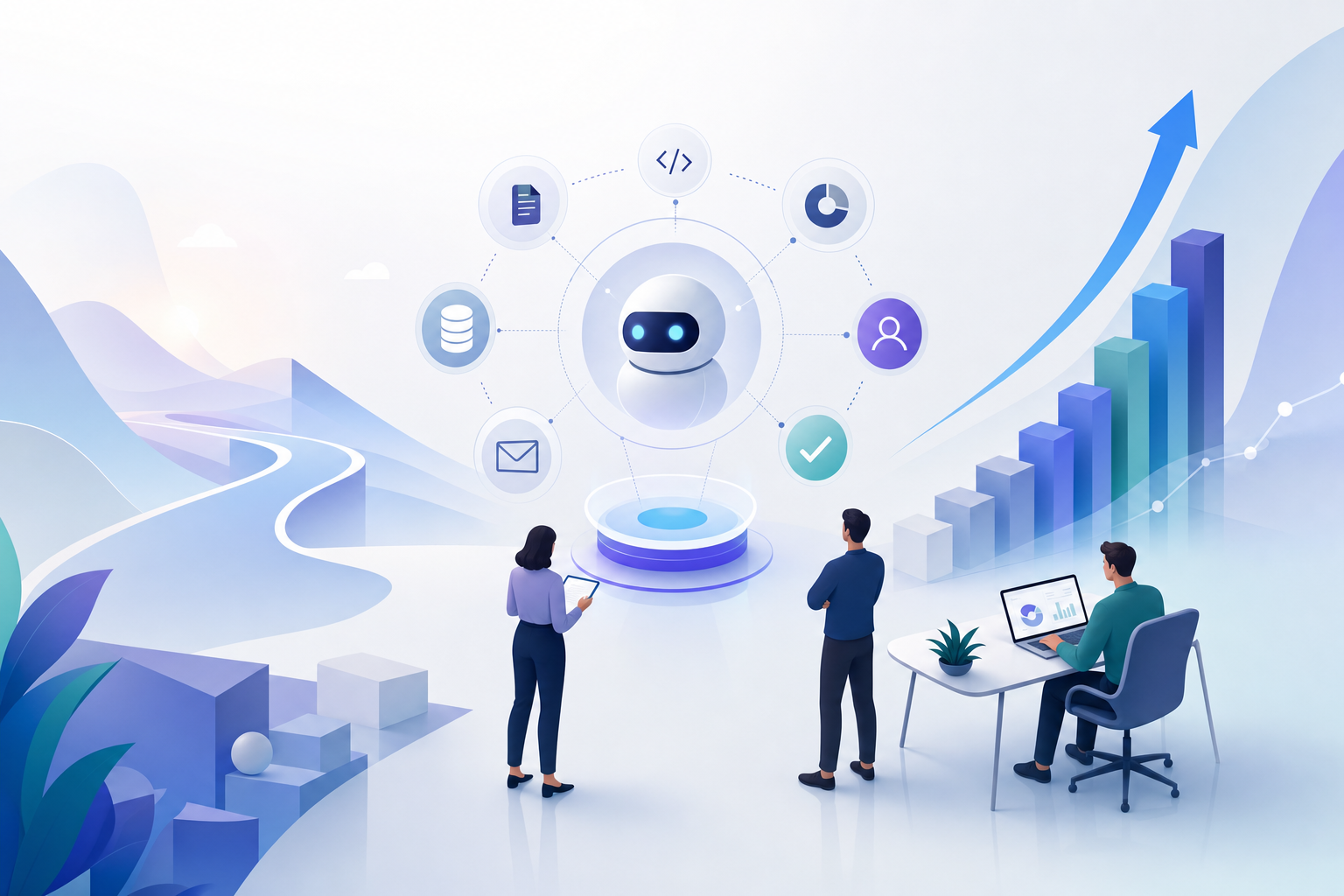
AI Agents Explained: What They Are and How Businesses Use Them
AI agents are software programs powered by artificial intelligence that can autonomously perceive their environment, make decisions, and take actions to achieve specific goals - with minimal human intervention. Unlike a simple chatbot that follows scripted responses, or basic automation that executes a fixed sequence of steps, an AI agent can reason about context, adapt to new information, break complex tasks into subtasks, use external tools, and adjust its approach when initial attempts do not work.
Definition: An AI agent is an autonomous AI system that can perceive its environment, reason about goals, plan a sequence of actions, execute those actions using available tools, and adapt based on results - going beyond simple question-answering to actually completing multi-step tasks.
AI Agents vs Chatbots vs Automation
Understanding the spectrum of AI tools helps you identify what your business actually needs:
| Capability | Rule-Based Chatbot | AI Chatbot (LLM) | AI Agent |
|---|
| Understands natural language | Limited (keyword matching) | Yes | Yes |
| Handles unexpected questions | No (falls back to default) | Yes | Yes |
| Takes actions in other systems | No | Limited | Yes (uses tools and APIs) |
| Multi-step reasoning | No | Within a conversation | Yes, across multiple systems |
| Learns from results | No | Within session only | Can adjust approach based on outcomes |
| Autonomous operation | No | No | Yes, within defined boundaries |
A rule-based chatbot answers "What are your hours?" by matching keywords. An AI chatbot powered by a large language model can have a nuanced conversation about your services. An AI agent can take a customer complaint, look up their order in your database, check the shipping status via an API, determine the appropriate resolution, issue a refund, and send a follow-up email - all autonomously.
Types of AI Agents
Task-Specific Agents
These agents are designed for a single, well-defined task: scheduling meetings, writing email drafts, generating reports from data, or monitoring social media mentions. They operate within narrow boundaries and excel at repetitive knowledge work that previously required human attention. Most businesses should start here.
Autonomous Agents
Autonomous agents have broader capabilities and more independence. Given a high-level goal like "Research competitors and create a comparison report," they can plan the necessary steps, gather information from multiple sources, synthesize findings, and produce the deliverable. These agents require careful guardrails because their autonomy means they can also make mistakes autonomously.
Multi-Agent Systems
In multi-agent architectures, multiple specialized agents collaborate on complex tasks. One agent might research, another writes, a third reviews and edits, and a coordinator agent manages the workflow. This mirrors how human teams work and can tackle problems too complex for a single agent.
Real Business Use Cases Today
Customer Support
AI agents can handle tier-1 customer support - answering common questions, processing refunds, updating account information, and escalating complex issues to human agents with full context. Companies using AI support agents typically report handling a significant portion of inquiries without human intervention, while improving response times from hours to seconds.
Sales and Lead Qualification
AI agents can engage website visitors, qualify leads based on predefined criteria, schedule discovery calls, and even draft personalized outreach emails. They can research prospects using public data and craft messages tailored to each company''s situation.
Content Creation
AI agents can draft blog posts, social media content, email newsletters, and product descriptions. The most effective approach uses AI for first drafts and research, with human editing for brand voice, accuracy, and nuance. Fully autonomous content publishing without human review remains risky due to hallucination and quality concerns.
Data Analysis
AI agents can connect to your databases and analytics platforms, run queries, identify trends, generate visualizations, and produce insights in plain language. This democratizes data analysis - non-technical team members can ask questions about business performance and get answers without writing SQL or building dashboards.
Current Capabilities and Limitations
It is important to have realistic expectations about what AI agents can and cannot do today:
What works well:
- Drafting and editing text content
- Summarizing large volumes of information
- Answering questions from a knowledge base
- Structured data extraction and transformation
- Code generation and debugging
- Workflow automation with well-defined steps
What remains challenging:
- Tasks requiring real-world judgment or ethical reasoning
- Consistent accuracy with precise numbers and facts (hallucination risk)
- Truly novel creative work (AI tends toward averages)
- Understanding context that requires deep domain expertise
- Long-running autonomous tasks without human checkpoints
Building vs Buying AI Solutions
For most startups, buying existing AI tools is far more practical than building custom agents. Building requires AI/ML expertise, significant compute costs, and ongoing maintenance. Use the build-vs-buy framework:
- Buy when AI is not your core product - use tools like Intercom for AI support, Jasper for content, or Clay for sales research
- Build custom when AI capability is your competitive advantage or when no existing tool fits your specific workflow
- Use a hybrid approach - leverage AI APIs (OpenAI, Anthropic, Google) to build custom agents using no-code or low-code tools that connect to your existing systems
When evaluating AI agents and tools, assess these factors:
- Accuracy for your use case - Test with your actual data and scenarios, not just demos
- Integration capability - Can it connect to your existing tools and data sources?
- Cost at scale - AI API costs can grow significantly with usage; model the economics
- Data privacy - Understand where your data goes, who can access it, and whether it is used for training
- Human oversight - Can you review outputs before they reach customers? Are there escalation paths?
- Vendor stability - The AI landscape is evolving rapidly; choose providers with sustainable business models
The Future of AI in Business
AI agents will become increasingly capable and integrated into business operations. The companies that benefit most will not be those that adopt AI first, but those that thoughtfully identify where AI creates genuine value - reducing costs, improving speed, or enabling capabilities that were previously impossible - while maintaining human oversight for decisions that require judgment, empathy, and accountability.
Key Takeaways
- AI agents go beyond chatbots - they can reason, plan, use tools, and complete multi-step tasks autonomously
- Start with task-specific agents for well-defined, repetitive knowledge work before exploring broader autonomy
- Customer support, sales qualification, content creation, and data analysis are the strongest business use cases today
- Buy existing AI tools unless AI is your core competitive advantage - building custom is expensive and complex
- Always maintain human oversight, especially for customer-facing outputs, due to hallucination and accuracy risks
- Evaluate AI tools on accuracy with your real data, integration capability, cost at scale, and data privacy
Frequently Asked Questions
Will AI agents replace human employees?
AI agents are best at augmenting human workers, not replacing them entirely. They excel at handling routine, repetitive tasks - freeing humans to focus on relationship-building, creative strategy, complex problem-solving, and judgment calls. The most effective implementations pair AI efficiency with human oversight and decision-making.
How much do AI agent tools cost?
Costs range from free tiers for basic AI chatbots to thousands of dollars per month for enterprise AI platforms. API-based pricing (like OpenAI) charges per token processed, which can range from a few cents for simple queries to dollars for complex, multi-step agent tasks. Always model costs at your expected scale before committing.
Are AI agents secure enough for business use?
Security depends on the specific tool and implementation. Key concerns include data privacy (where is data sent and stored?), prompt injection (can users manipulate the AI into unintended actions?), and access controls (what systems can the agent access?). Use AI tools that offer enterprise security features and always limit agent permissions to the minimum required.
How do I get started with AI agents?
Start by identifying one repetitive, time-consuming task in your business that follows relatively consistent patterns. Implement an AI solution for that specific task, measure the results (time saved, accuracy, cost), and iterate. Do not try to automate everything at once - successful AI adoption is incremental.
What is the difference between AI agents and RPA (Robotic Process Automation)?
RPA bots follow rigid, predefined rules to automate structured tasks like data entry and form filling. AI agents use language models to understand context, handle unstructured data, and make decisions. Think of RPA as a very fast, precise robot following instructions, while an AI agent is more like a junior employee who can think and adapt. Many organizations use both together.